

News and Insights

5 "Safe" Assets Working Against Your Retirement

A hefty cash cushion brings comfort, especially when you’re afraid of losing the wealth you’ve worked hard for.
But that’s exactly what’s happening if you keep too much in cash.
Say you set aside $1 million in 2016 as a safety net. If you didn’t touch that money and the balance stayed exactly the same, you still lost nearly 30% of your buying power to inflation.
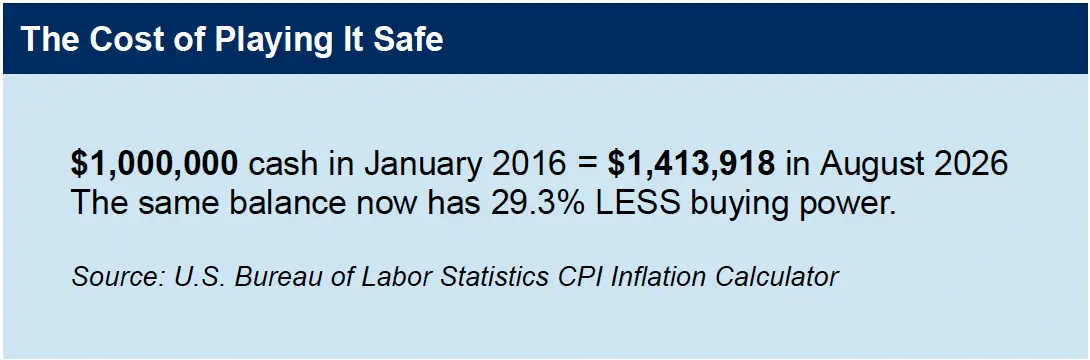
Cash is the simplest example of an asset that feels secure while sneakily working against you, but it’s not the only one.
Here are five “safe” assets worth reevaluating while you still have time to switch up your strategy.
1. Is Holding Too Much Cash Risky In Retirement?
When it makes sense:
Every retirement needs cash, whether it’s an emergency fund, money for big expenses you know are coming in a year or two, or enough of a cushion so a market drop doesn’t force you to sell investments. I won’t discount the peace of mind it brings, either. Plenty of people with over a million dollars in investments also want that sleep-well-at-night fund.
Where it starts working against you:
If the cash you hold is only making you feel secure, that’s a problem. I’ve seen bank balances higher than $1 million. And that comfort costs you buying power every year your cash sits without growing.
2. Are Fixed-Payment Annuities Safe From Inflation?
When it makes sense:
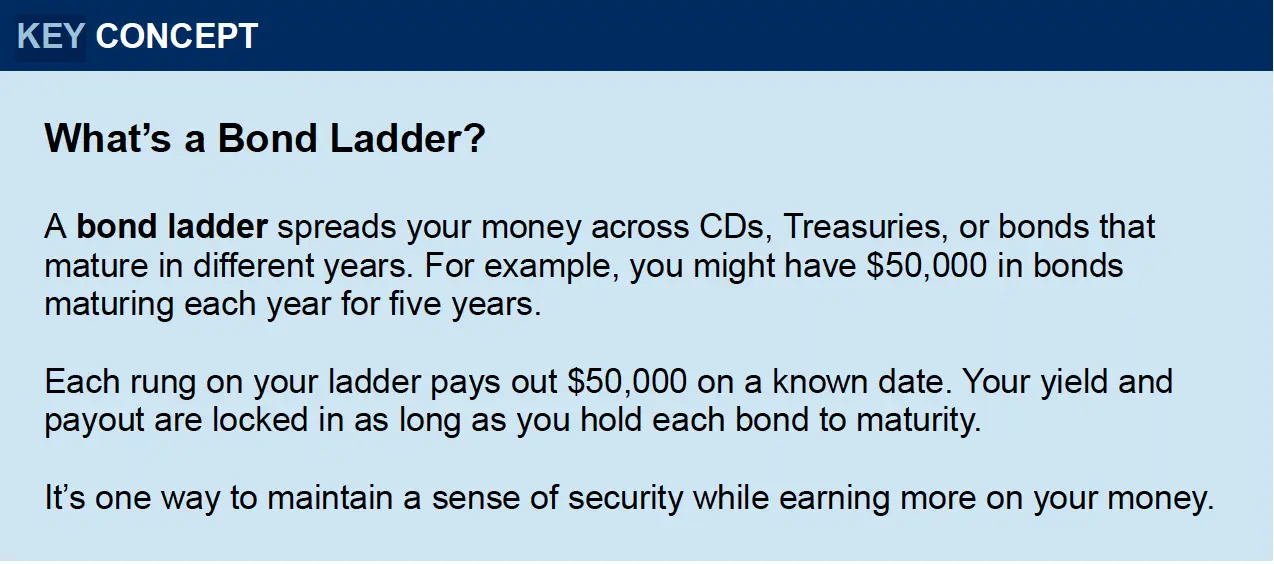
Annuities can be useful when you want a dependable source of lifetime income. You can use one to cover essential expenses (alongside Social Security or a pension) to take some pressure off the rest of your portfolio. Many annuities now offer income that rises each year, which helps with inflation.
Where it starts working against you:
Many older annuities pay a flat amount that never increases. It may feel like plenty in year one, but by year 10 or 15 it may barely cover what it used to as healthcare and housing costs rise.
The main problem, though, is when too much of your wealth goes in. I’ve met people who put 90% or more of their investable net worth inside annuities years ago. When most of your money is tied to a contract, a home repair or medical bill becomes much harder to cover.
And at that point, there’s often little we can do without triggering surrender charges or taxes, or giving up the benefits they’ve already paid for.
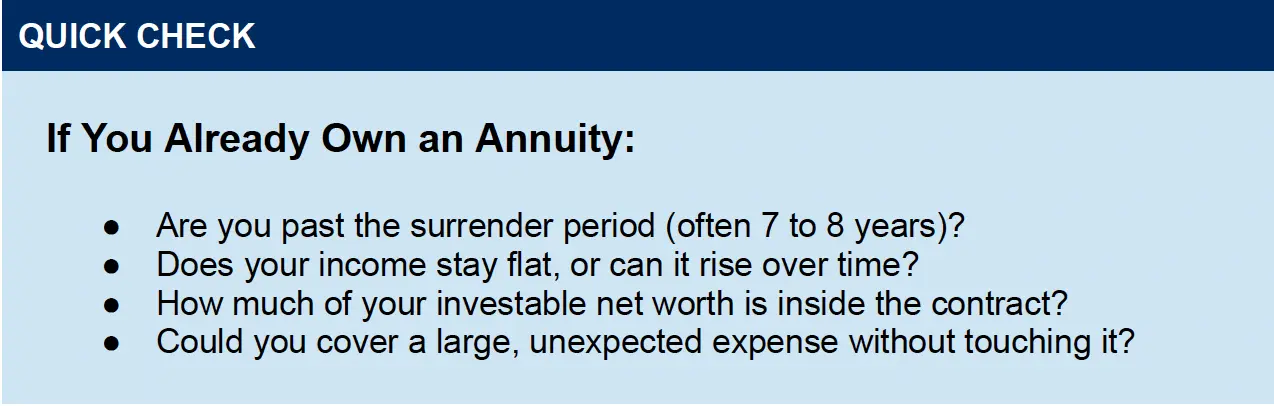
If you’re past the surrender period and interest rates are higher now than when you bought, a new contract may offer more or increasing income.
3. Is Life Insurance a Good Retirement Investment?
When it makes sense:
Permanent life insurance can be useful for specific estate planning needs or if you need coverage that lasts a lifetime. For high networth investors, it may make sense to have a whole life insurance product that is designed for high cash accumulation. This can act as both an insurance product and a lower-risk bond alternative. But it has to make sense with the rest of the allocation of assets.
Where it starts working against you:
In the fine print of many of these products, you’ll often find layers of fees, surrender charges, and restrictions that benefit the insurance company far more than you. I am especially cautious of Indexed Universal Life Insurance sold as a retirement investment, especially when the “tax-free” component of them is overstated and/or flat-out described incorrectly.
They also tend to get sold beyond the situations they’re made for. (I’ve seen them make up 50% to 70% of someone's portfolio.) It pains me to see so much money locked into products that don’t serve the person who owns them.
4. Are High-Yield Dividend Stocks Safe for Retirement?
When it makes sense:
Dividend-paying stocks can be a solid source of retirement income when the company’s earnings support the payout. I usually prefer dividend growth strategies, though. These companies have a long history of raising their dividend each year. This gives your income room to keep pace with inflation while allowing your investments to appreciate.
On the surface I do not dislike High-Yield Dividend stocks. I only dislike them when they are a core strategy rather than a part of a cohesive investment strategy.
Where it starts working against you:
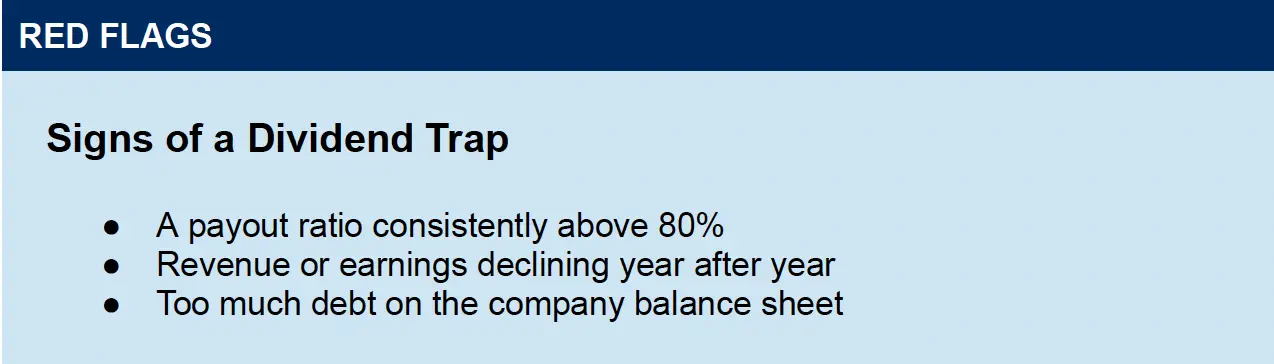
The trouble starts if a high yield was the main reason you bought. A 7% or 8% yield may be high because the stock price has fallen as company revenue declines. That adds pressure on the payout ratio. When it stretches too far, the company might cut or eliminate the dividend. You can lose both your income and principal at the same time.
5. What Are the Risks of High-Yield Closed-End Funds?
When it makes sense:
Some closed-end funds generate their distributions from real income. If you understand the fund, it has reasonable fees, and it uses limited leverage, it can play a role in an income portfolio. Just know exactly where the payments come from.
Where it starts working against you:
Once, someone came to me with a portfolio made up almost entirely of closed-end funds, many yielding around 10%. Those steady checks made them feel comfortable.
But under it all, many of the funds used leverage and charged high fees. Their income wasn’t enough to support the distributions. As a result, each payment included a return of capital. In this case, the funds were effectively giving investors their own money back. Checks kept coming while their portfolios shrank, and leverage exacerbated the problem.
Ultimately, we simplified that client’s portfolio. It meant accepting losses on some positions, but we could then rebuild it around investments with more transparent sources of income.
What “Safe” Means in Retirement
None of these assets are bad on their own. They feel safe because they avoid certain visible risks. Unfortunately, they also bring in risks that are tougher to see, like inflation, hidden fees, shrinking principal, or illiquidity.
Before you lean on assets for security, ask yourself:
- What job is the money doing in my plan?
- Can I reach it if life takes an unexpected turn?
- Do I know where the return/income is coming from?
- What would it cost me to change course?
You can gain flexibility by reducing your reliance on any one 'safe' asset. We do this by building separate buckets for income, growth, and unexpected expenses. The goal is to have money that keeps working for you and is there when you need it.
The content in this material is for general information only and is not intended to provide specific advice or recommendations for any individual.
Follow us on YouTube!
Let's Meet


About the author: Nathan Lee is a CERTIFIED FINANCIAL PLANNER® and Behavioral Financial Advisor at Servet Wealth Management in New York City. He works with individuals and families navigating important financial decisions, including retirement planning, tax strategy, investing, income planning, and wealth management. Through his blog and YouTube channel, Nathan explains complex financial topics in a practical, easy-to-understand way.

I read every email and would love to hear if this blog helped you.


