

News and Insights
.webp)
A Balanced Look at the SpaceX IPO
-optimized.webp)
With SpaceX preparing for a highly anticipated IPO on June 12th, I wanted to share some of my most interesting things I've read about this IPO. SpaceX is clearly one of the most innovative and important private companies in the world. Between its rocket launch business, Starlink, and its longer-term ambitions in space infrastructure and artificial intelligence, it is easy to understand why there is so much excitement around the company going public.
With that said, excitement and investment discipline are not always the same thing.
One of the biggest questions is valuation. The IPO would reportedly value SpaceX at approximately 95 times its $18B in revenue, despite a reported $5B loss. Morningstar recently estimated SpaceX’s fair value below the valuation being discussed for the IPO. That does not mean Morningstar is automatically right or that the market will agree, but it does highlight the risk that public investors may be paying a very high price for future growth that still needs to materialize.
>>Morningstar Valuation Discussion via CNBC
At the same time, high valuations alone do not mean a great company cannot become a great investment. Amazon is a good example. There were many periods when Amazon appeared to be trading well ahead of its current revenue, and yet, looking back over the past 10 years, investors were still presented with attractive entry points along the way. SpaceX may eventually prove to be similar. The question is not whether the company is exceptional. I believe it is. The question is whether the IPO price gives investors enough margin of safety, or whether patience may create a better opportunity after the initial excitement settles.
For investors who want to go deeper, Morningstar also put together a helpful breakdown of SpaceX’s S-1 financials and key business metrics. This can help separate the business fundamentals from the excitement surrounding the IPO.
>>Morningstar Breakdown of SpaceX’s S-1 Financials
There are also structural factors to consider. SpaceX is expected to have strong demand from both retail and institutional investors, and because of newer Nasdaq rules, it may be eligible for faster inclusion in major indexes. SpaceX could potentially enter popular index funds in as little as 5 trading days if it meets the required criteria. SpaceX IPO alone could generate more exit value than all IPOs over the last decade combined, which helps explain why this offering is getting so much attention. That matters because many investors may end up owning SpaceX indirectly through their 401(k), IRA, or other index-based investments, even if they never buy the stock directly.
>>Yahoo Finance on SpaceX and Index Fund Inclusion
Here is the basic idea behind the rule changes:
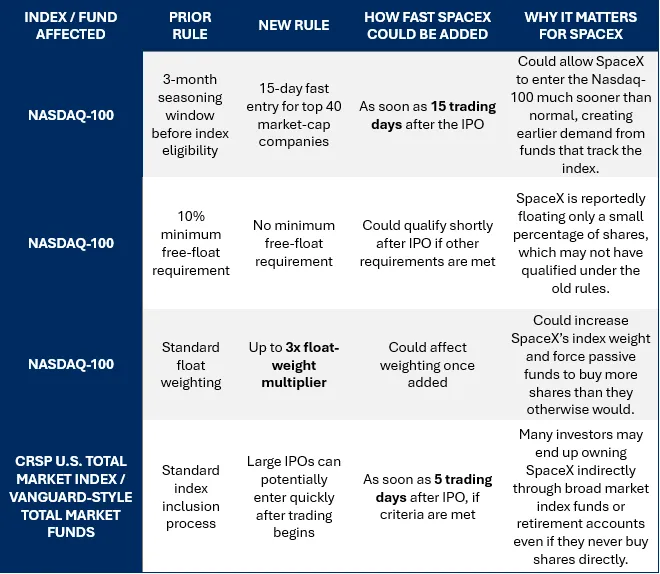
This is important because forced or rapid index buying can create short-term demand for a stock. That does not automatically mean the company is overvalued or that the stock will perform poorly, but it does mean early trading could be influenced by market mechanics, fund flows, and investor excitement, not just business fundamentals.
Traditionally, the S&P 500 has had a more conservative inclusion process. Companies usually need to be public for a meaningful period of time and demonstrate profitability, including positive GAAP earnings over the required lookback period, before being considered for inclusion. Tesla is a good example. It went public in 2010 but was not added to the S&P 500 until late 2020, largely because it needed to meet the index’s profitability requirements. In SpaceX’s case, there has been discussion around whether those rules could be revisited for a company of this size. But even if that happens, the timeline being discussed appears closer to six months, not days or weeks.
Another important point is the lockup structure. SpaceX is reportedly using a tiered lockup schedule rather than a traditional single 180-day lockup. The reported structure includes a rolling schedule where additional shares become eligible for sale at different points after the IPO, including 70, 90, 105, 120, and 135 days. The goal is to reduce the risk of one large wave of insider selling hitting the market all at once. That is a thoughtful structure, but it does not eliminate volatility. When early investors, employees, and other shareholders are sitting on substantial gains, it would not be surprising to see some of them sell a portion of their shares once they are allowed to do so. As more shares become available over time, the stock could face additional selling pressure, especially if the IPO valuation is already aggressive. I also find the timing notable: the lockup releases appear to be accelerating around the same period when index inclusion could create
forced buying from passive funds. In other words, potential selling from early shareholders may be met by required buying from index funds, which could influence the stock’s early trading dynamics.
The broader takeaway is this: SpaceX may become a great long-term public company, but that does not mean every investor needs to rush into the IPO, especially at a valuation above $1.7 trillion. IPOs can be emotional because they often combine a compelling story, limited access, media attention, and fear of missing out. For many investors, the better approach may be to watch how the company trades after it becomes public, evaluate the financials with more transparency, and make sure any position fits within a diversified portfolio.
Very few businesses have the potential to reshape multiple industries the way SpaceX has. With that said, a lot of the value may already be reflected in the current valuation, especially when compared to its current revenue. Could this be an interesting short- to medium-term trade? Possibly. There may be strong demand, limited supply, and index-related buying that supports the stock early on. But for long-term investors, I believe there may be better entry points after the initial IPO excitement settles. And when SpaceX is added to major indexes over time, there is a good chance many investors will end up owning it indirectly through funds they already hold anyway.
Follow us on YouTube!
Let's Meet
.png)
.png)
.png)
.webp)
About the author: Nathan Lee is a CERTIFIED FINANCIAL PLANNER® and Behavioral Financial Advisor at Servet Wealth Management in New York City. He works with individuals and families navigating important financial decisions, including retirement planning, tax strategy, investing, income planning, and wealth management. Through his blog and YouTube channel, Nathan explains complex financial topics in a practical, easy-to-understand way.

I read every email and would love to hear if this blog helped you.
.png)
.png)

