

News and Insights
.webp)
How Higher Interest Rates Make Bonds More Attractive to Investors
Higher interest rates can make high-quality bonds more attractive because investors can earn more income without taking the same risks as owning stocks. That can encourage some investors to shift part of their portfolio toward bonds, especially when the additional return they expect from stocks looks less compelling.
For someone approaching retirement, this raises a useful question: Could your financial plan succeed with less stock-market risk than you are taking today?
As a financial advisor, that is the conversation I want to have. Your portfolio needs to support your spending, your family, and your future. When the available investment choices change, it makes sense to revisit how you are using them.
Why do higher bond yields compete with stocks?
Investors have choices about where to put their money. When relatively safe investments offer very little income, accepting stock-market uncertainty may feel more worthwhile. When high-quality bonds offer more meaningful income, the trade-off changes.
PIMCO explores this in “Welcome Back, Balanced Portfolio.” Its argument is that higher starting yields give bonds a stronger role in a portfolio: providing income and potentially helping cushion losses when economic growth weakens.
Imagine reviewing your investments and asking, “If I can meet more of my spending needs through dependable interest payments, do I still need this much in stocks?”
You do not need to believe a market decline is coming to ask that question. You may simply have a better income option than you had before.
What could higher bond income mean for retirement?
Consider a hypothetical $500,000 investment in fixed-rate bonds purchased at face value: Annual coupon rate Annual interest income
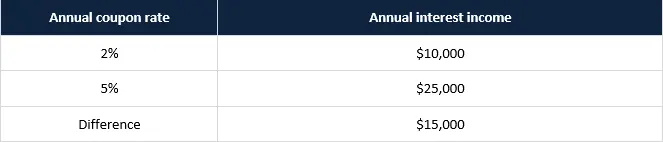
An additional $15,000 a year could cover a meaningful portion of a household’s expenses. It could also reduce the amount that needs to come from selling investments.
Suppose a couple needs $40,000 annually from their portfolio after accounting for Social Security and other income. In this simplified example, $10,000 of bond interest leaves $30,000 to fund from other sources. With $25,000 of interest, that remaining amount falls to $15,000.
That does not mean the couple’s plan is solved. We still need to account for inflation, taxes, unexpected expenses, and what happens when the bonds mature. But it gives us a concrete reason to revisit how their portfolio supports their withdrawals.
How much extra return should stocks offer?
The additional return investors expect from stocks above a relatively safe investment is called the equity risk premium. It is compensation for accepting uncertainty, including the possibility of substantial losses.
Schwab’s 2026 long-term capital market expectations put projected U.S. large-cap stock returns at 5.9% annually, or roughly 6%, over 2026–2035. This is a forecast of annualized total returns before inflation, taxes, and fees, based on data through October 31, 2025. It is not a promise of 6% every year.
That gives us a concrete reason to ask: Is the additional risk worth the potential reward? If high-quality bonds can provide a meaningful portion of the return your plan needs, how much more potential return would justify taking on the uncertainty of stocks?
The answer depends on what that money is supposed to do. Someone investing for a child’s future may answer differently from someone using the portfolio to replace a paycheck next month. The possibility of a higher return matters, but so does your ability to stay invested through a difficult market.
Of course, U.S. large-cap stocks are only one part of the investment landscape. International stocks, smaller companies, real estate, and different bond categories can have different return prospects and risks. That is why I would evaluate the mix of investments that supports your goals, rather than make the entire decision a choice between the S&P 500 and Treasuries.
You may also see comparisons between Treasury yields and the S&P 500’s earnings yield. Earnings yield measures company earnings relative to the price investors pay. It is not an interest payment to shareholders or a forecast of their total return. Earnings growth, dividends, and changes in valuations all affect the comparison.
Do higher interest rates always cause stocks to fall?
Not directly. More attractive bond yields can affect investors’ choices, but they do not establish a reliable stock-market sell signal. Corporate earnings can grow, and the price investors are willing to pay for those earnings can change. It’s largely why the stock market has remained strong this year in the face of rising yields.
There is also a distinction between an individual changing their allocation and money disappearing from the stock market. When you sell shares, another investor buys them. What can change is the price buyers require to make owning those shares worthwhile compared with the alternatives.
For planning purposes, I would use higher yields as a reason to review your allocation, rather than as a prediction about next month’s market return.
Higher interest rates can also put pressure on stocks by making it more expensive for businesses to borrow. Smaller and midsize companies that rely on financing to expand may have to delay projects or spend more on interest, leaving less room for profits. If those costs keep earnings from meeting investors’ expectations, stock prices can come under pressure. So while higher yields don’t automatically cause stocks to fall, they can make growth more expensive, and expectations harder to meet.
Are bonds safe when interest rates rise?
Bonds still carry risk. Prices of existing fixed-rate bonds generally fall when market interest rates rise. Longer maturities generally increase that sensitivity.
This explains an apparent contradiction: rising rates can hurt bonds you already own while improving the income opportunities available for new purchases.
If you hold an individual bond to maturity and the issuer pays as promised, you receive its face value. Selling before maturity may produce a loss. Traditional bond funds do not give each shareholder a fixed maturity date at which their original investment is returned.
Inflation can also erode the purchasing power of fixed payments, and issuers can fail to pay. Lower-quality bonds often offer higher yields precisely because they involve greater credit risk.
PIMCO also notes that bonds and stocks can fall together, as they did in 2022. A diversified portfolio still needs to be prepared for difficult periods.
How can a bond ladder match retirement expenses?
A bond ladder is a collection of individual bonds with different maturity dates. For retirement spending, we can select bonds scheduled to mature shortly before the money is needed, using their interest payments and returned principal to help cover planned expenses.
For example, suppose you expect to need another $40,000 each year for the next three years after accounting for Social Security, other income, and the interest your bonds will pay. We could consider a ladder with $40,000 of face value maturing before each year’s withdrawals begin. Assuming the issuers pay as promised, each maturity would supply that year’s remaining $40,000. The amount needed to purchase those bonds would depend on their market prices. The bonus is now you get paid a higher yield to put this structure into place.
The principal coming back is your own money being returned, not an additional investment gain. Spending it gradually uses up the ladder, so the plan also needs to address expenses beyond those three years.
What I like about this approach is the connection between the investment and its purpose. You can identify which assets are intended to cover upcoming spending. That can reduce the need to sell stocks during a downturn and give investments intended for later years more time to recover, although recovery is never guaranteed.
I would favor high-quality, noncallable bonds for precise expense matching, because an early redemption could disrupt the schedule. We would also account for taxes, inflation, and monthly cash needs, keeping enough cash available between payment dates. Bond values can still fluctuate before maturity, and repayment depends on the issuer.
A ladder can fund a defined period of spending. Maintaining it beyond that period requires additional funding or reinvestment, and future yields may differ. Its role in your plan should be reviewed as your expenses change.
Should retirees move money from stocks into bonds?
That decision should start with your financial plan. I would want to understand:
- Your income gap: How much must the portfolio provide after Social Security and other income?
- Your timing: Which dollars will you spend soon, and which can remain invested for years?
- Your flexibility: Could you adjust withdrawals during a difficult market, or are those expenses essential?
- Your tax situation: What would you keep after taxes, and would selling existing investments create a tax cost?
- Your long-term goals: How much growth might you need to support future spending and the legacy you want to leave?
Those answers bring us back to the opportunity higher bond yields create. If high-quality bonds can now support more of your income needs, it is worth reconsidering how much stock-market risk you need to take. The potential reward should justify that risk in the context of your own plan.
A bond ladder makes that conversation tangible. Matching maturity dates to upcoming expenses can give you a clearer picture of where your retirement spending will come from. Alongside that, stocks and other assets can remain invested for goals further down the road, with an allocation that reflects their different risks and return potential.
The right balance will look different for every household. You may still need meaningful growth to support a long retirement or the legacy you want to leave. But if your plan can meet its goals with less exposure to market swings, that deserves serious consideration.
At Servet Wealth Management, we can start by mapping your expected withdrawals over the next several years, reviewing the income your portfolio can provide, and evaluating where bonds with specific maturities might fit. From there, we can assess how much risk makes sense for the rest of your investments.
You have worked hard to build your savings. As your choices change, your portfolio should continue to reflect what that money needs to do for you: support your spending today, provide for the years ahead, and help you feel comfortable living the retirement you have planned.
Reach out to us by clicking here.
Let's Meet!
.png)
.png)
.png)
.webp)
About the author: Nathan Lee is a CERTIFIED FINANCIAL PLANNER® and Behavioral Financial Advisor at Servet Wealth Management in New York City. He works with individuals and families navigating important financial decisions, including retirement planning, tax strategy, investing, income planning, and wealth management. Through his blog and YouTube channel, Nathan explains complex financial topics in a practical, easy-to-understand way.

I read every email and would love to hear if this blog helped you.
.png)
.png)

