

News and Insights

The 3 Types of Retirees Who Should Claim Social Security at 62
Is Waiting Until 70 Really the Best Social Security Strategy?
“Wait as long as you can to claim Social Security.” It is good advice for certain retirees, but it assumes everyone has the same financial circumstances. Waiting until age 70 provides a larger monthly benefit for life, yet it also means passing up eight years of payments that could have supported your spending or reduced withdrawals from investments.
After helping hundreds of retirees evaluate Social Security decisions, I have found three situations where claiming at 62 deserves serious consideration. The right answer depends not just on the size of the check, but also on taxes, investments, Medicare premiums, survivor benefits and how you want to spend your retirement.
By the Numbers: Social Security at 62 Versus 70
For people born in 1960 or later, full retirement age is 67. Claiming at 62 generally provides 70% of the full benefit; waiting until 70 provides 124%. A $2,600 full-retirement-age benefit would therefore be approximately $1,820 at 62 or $3,224 at 70, before future cost-of-living adjustments. That is about a 77% larger monthly starting benefit from waiting.
For married couples, delaying the higher earner’s benefit may also improve the survivor benefit. But three questions are worth asking first: Will delaying create a real tax-planning opportunity? Is a spouse relying on your benefit for survivor income? And are you likely to live long enough for larger checks to offset the payments you gave up? The examples below assume you are retired; working before full retirement age may introduce Social Security’s earnings test.
1. The Retiree With Significant IRA Savings Who Is Not Doing Roth Conversions
One of the strongest reasons to delay Social Security is the chance to use the years before benefits begin for Roth conversions. I call this the golden window: a period after employment income stops but before Social Security and required minimum distributions begin, when some retirees can fill lower tax brackets by strategically converting traditional IRA money to Roth.
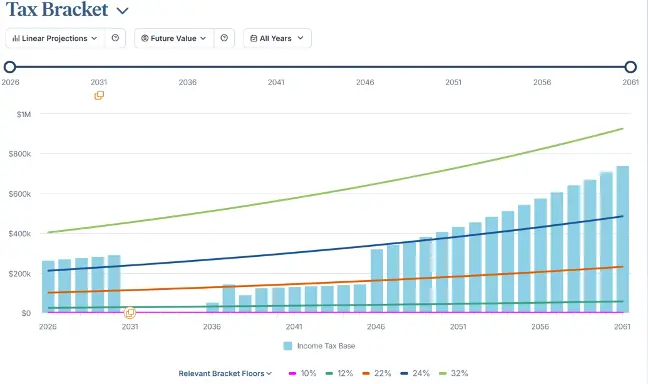
Now imagine a single retiree who is 62, has $1.5 million entirely in a traditional IRA and spends $85,000 a year. His monthly benefit would be $2,625 at 62 or $4,650 at 70. He has no spouse whose survivor benefit needs protecting and does not intend to make Roth conversions. Because his savings are pre-tax, delaying Social Security forces him to withdraw more from the IRA to cover both spending and taxes. In that situation, there
isn’t a big golden window opportunity where it would make sense to do that conversion given where the rest of his portfolio is.
How Claiming Earlier Changes IRA Withdrawals
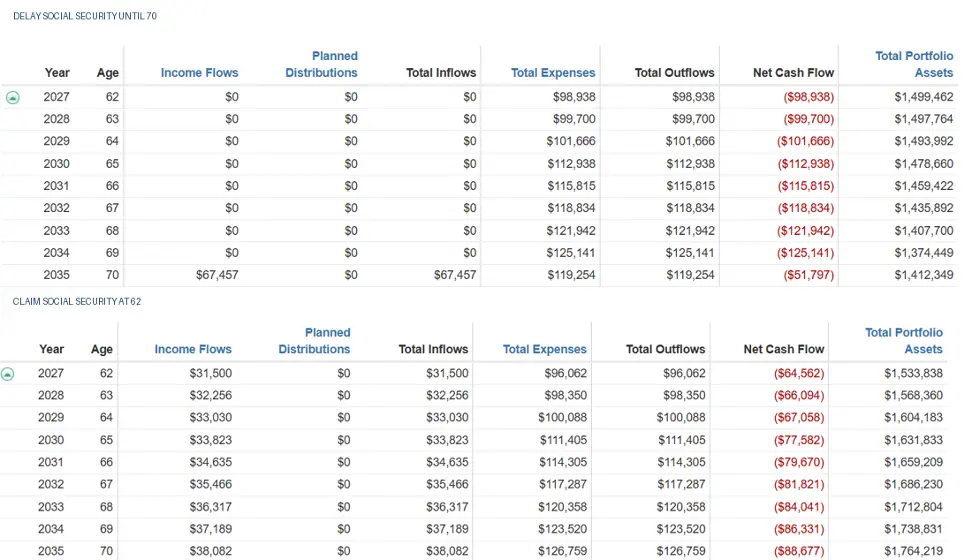
In our financial planning projection, waiting until 70 requires about $98,938 in total first-year outflows, rising to $125,141 by age 69, funded primarily by the IRA. Claiming at 62 immediately provides $31,500 of Social Security income, reducing the first-year funding gap to $64,562. The smaller IRA withdrawals matter because traditional IRA distributions are ordinarily taxable, while only a portion of Social Security may be included in taxable income.
The Unexpected Tax Result
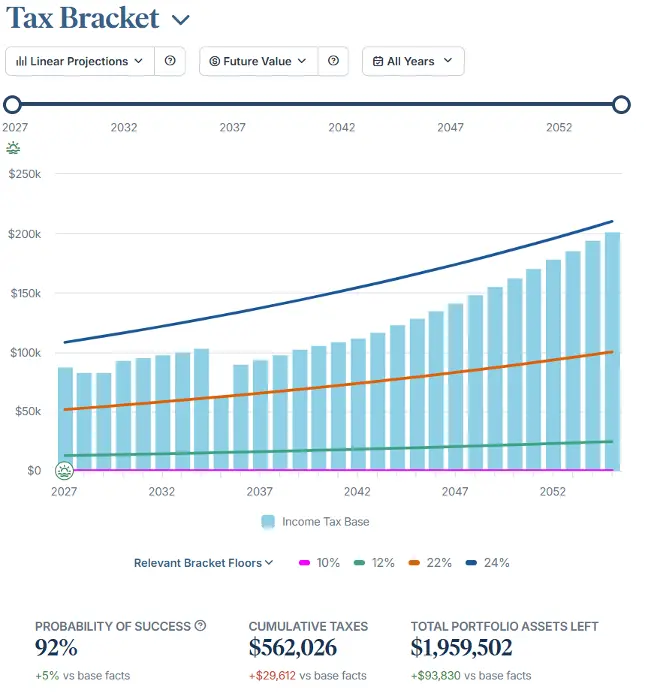
Under these assumptions, the claim-at-62 scenario produces $532,414 in cumulative projected taxes, versus $562,026 when Social Security starts at 70—a difference of $29,612. The delayed strategy does not create an especially valuable Roth conversion opportunity because the retiree’s spending already requires substantial taxable IRA withdrawals. A retiree with taxable savings and a deliberate conversion program might find delaying much more attractive.
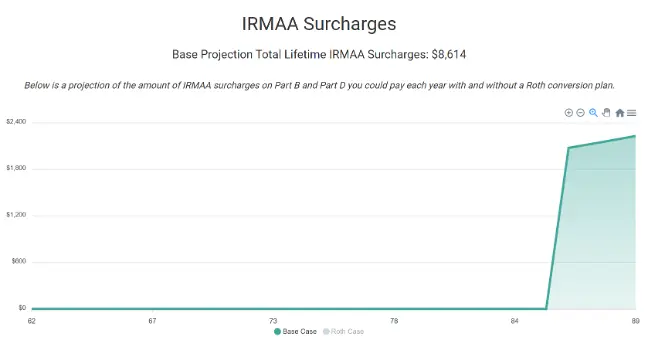
Medicare is another piece of the calculation. IRMAA surcharges raise Part B and Part D premiums when income crosses certain thresholds. The delayed scenario triggers an estimated $8,614 in lifetime IRMAA surcharges, while the early-claiming projection remains below the surcharge thresholds. These are modeled results, not a forecast of future Medicare rules or premiums.
Why the Portfolio Break-Even Age Moves to 87–88
A traditional Social Security break-even analysis compares cumulative benefit checks. But it leaves out what happens to investments when one strategy requires larger early withdrawals. In our model, claiming at 62 preserves more IRA assets during the eight-year bridge period, allowing more money to remain invested. At age 70, projected portfolio assets are $1,764,219 for early claiming versus $1,412,349 for delaying—a $351,870 difference.
Once the larger age-70 benefit starts, the delayed strategy begins to catch up. Yet at age 80, the early strategy still has $195,565 more in portfolio assets; at age 85, it is ahead by $62,941. The gap narrows to about $2,583 at age 87, and waiting eventually comes out ahead. By age 90, delaying is projected to leave approximately $93,830 more in assets. The practical break-even is therefore around age 87 or 88 if you are able to generate a return on money that stays in the portfolio.

This does not mean claiming at 62 is the best strategy for everyone with an IRA. Returns, spending, taxes, inflation and longevity all affect the results. This also does put more risk on the retiree to generate a higher return profile. It does demonstrate why an integrated retirement plan can tell a different story than an isolated Social Security calculation.
2. The Lower-Earning Spouse in a Marriage
For a married couple, Social Security is a household decision. After the first spouse dies, the surviving spouse generally receives the larger applicable benefit rather than both checks. Delaying the higher earner’s benefit can therefore provide valuable income protection, while delaying the lower earner’s smaller check may not create the same survivor advantage.
Suppose Nancy and John are both 62. Nancy’s full benefit at 67 is $1,600 a month, and John’s is $4,000. If Nancy claims at 62, her own payment starts at $1,120, before subsequent COLAs. If John later claims at 67, Nancy may qualify for an additional spousal amount: half of John’s full benefit is $2,000, and the difference between that amount and Nancy’s own full benefit is $400. Assuming Nancy has reached full retirement age when the spousal addition begins, the simplified combined amount is her reduced personal benefit plus that spousal benefit.
If John dies later, Nancy might become entitled to a larger survivor benefit based on his record. Spousal and survivor benefits have detailed eligibility and claiming rules, so this example should not be treated as a onesize-fits-all formula. The central point is that collecting the smaller benefit earlier while protecting the larger one can be a reasonable strategy for some couples.
3. The Retiree With a Shorter Life Expectancy or utilize the money in their healthy years
Health and family longevity history also matter. Delaying Social Security can be particularly valuable for someone in excellent health who may need income well into their 90s. But for someone with serious health concerns, giving up eight years of benefits to receive a larger check later may be a less attractive exchange.
The issue is more than mathematical. Your 60s and early 70s may be the years when travel, time with family and other activities are most enjoyable. Receiving income while you are healthier can have real value, even if a larger benefit might eventually win in a long-lived projection. A larger check at 85 cannot bring back a healthy year at 67.
There is an important exception: a higher-earning spouse with a shorter personal life expectancy may still choose to delay to protect a healthier spouse’s future survivor benefit. Your own longevity is only one part of the decision.
What About Social Security’s Financial Future?
The 2026 Social Security Trustees Report projects that the retirement and survivors trust fund can pay full scheduled benefits through the fourth quarter of 2032. If lawmakers make no changes, continuing income would cover about 78% of scheduled benefits afterward. That is a funding projection, not a confirmed 22% reduction, and claiming early does not necessarily protect anyone from future legislative changes. It is a factor worth monitoring, but not a substitute for an individualized claiming analysis.
Who May Be Better Off Waiting?
Two groups deserve particular consideration before claiming early: higher-earning spouses whose benefits may support a surviving partner, and retirees who can genuinely use a low-income golden window for Roth conversions. In those cases, delaying Social Security may create more value than collecting it early, even if it requires funding the interim years from savings.
The Largest Check Is Not Always the Best Retirement Outcome
The most useful question is not “How can I get the largest Social Security check?” It is “Which claiming strategy makes my overall retirement better?” For some, the security of a higher guaranteed lifetime benefit makes age 70 compelling. For others, starting at 62 may preserve investments, reduce lifetime taxes or make more money available during their healthiest years. Social Security decisions belong alongside investment withdrawals, tax planning, Medicare costs and family priorities—not apart from them.
Prefer to watch?
Disclosure: This article is educational and is not individualized financial, tax or legal advice. Illustrations are hypothetical, depend on modeled assumptions, and do not guarantee actual results.
Follow us on YouTube!
Let's Meet


About the author: Nathan Lee is a CERTIFIED FINANCIAL PLANNER® and Behavioral Financial Advisor at Servet Wealth Management in New York City. He works with individuals and families navigating important financial decisions, including retirement planning, tax strategy, investing, income planning, and wealth management. Through his blog and YouTube channel, Nathan explains complex financial topics in a practical, easy-to-understand way.

I read every email and would love to hear if this blog helped you.


