

News and Insights
.webp)
Which Account Should You Draw From First in Retirement?

You have enough for retirement, but how should you use it?
When people retire, most ask whether they can afford to stop working and still do the things that matter to them.
That’s a good place to start, but the next question receives far less attention: Where should the money come from each year?
A dollar in a taxable brokerage account, a dollar in a traditional 401(k), and a dollar in a Roth IRA can have the same investment value and very different tax consequences.
Drawing from the wrong one at the wrong time can cost you in taxes, flexibility, or both.
The tricky part is that no formula or single order works for everyone. That doesn’t mean, though, that your choices don’t matter.
By the Numbers
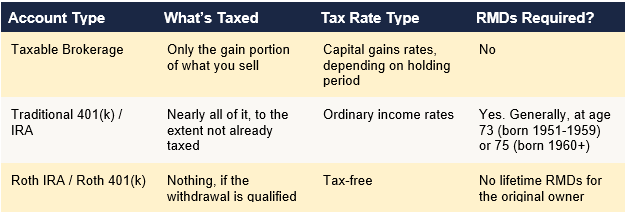
How Each Account Is Taxed When You Withdraw
So, Which Account Comes First?
There isn't a single order that works for everyone. But a useful place to start is by asking what you're trying to accomplish in a given year.
If taxable savings can cover your spending while you're in a relatively low-income year, using those assets alongside strategic Roth conversions may help reduce future RMDs and create greater tax flexibility.
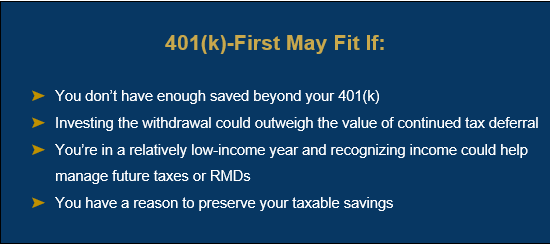
In other situations, deliberately drawing from a traditional 401(k) or IRA earlier may make more sense — particularly if you have limited taxable savings, want to preserve those assets, or have an opportunity to recognize ordinary income at a relatively low rate.
The goal isn't to pick an account order once. It's to decide which accounts should fund this year's spending without creating a bigger problem later.
Why Spending Your Taxable Account First Can Make Sense
Because only the realized gain (not the entire amount sold) is potentially taxable, taxable assets may provide spending cash without generating as much ordinary income as the same-size traditional 401(k) withdrawal.
If your taxable account can cover your living expenses, one approach is to spend from it while completing a deliberate Roth conversion each year. The conversion moves a chosen amount from a traditional IRA or 401(k) into a Roth, taking advantage of your current (and possibly lower) tax bracket.
Done thoughtfully, this can reduce future Required Minimum Distributions (RMDs) and add flexibility to your taxable income later in retirement.
This matters more if you’re planning around a spouse with a small Social Security benefit, as the surviving spouse will eventually file as a single taxpayer and lose some of that flexibility.

When Drawing From Your 401(k) Earlier Can Also Make Sense
Now, the taxable-first approach isn’t automatically the better option.
There may also be years when deliberately recognizing some ordinary income makes sense — for example, if you’re currently in a lower tax bracket than you expect once RMDs and other income begin.
Some retirees are also uncomfortable spending down their personal savings first, because they worry about becoming more reliant on retirement accounts or government benefits later if their circumstances change.
Most often, though, it’s as simple as not having enough outside the 401(k) to begin with. For many people, taking from that account isn’t a choice at all.
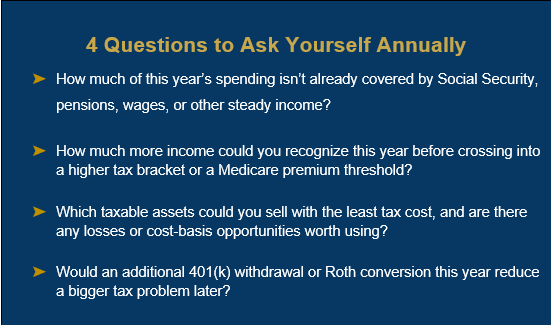
The decision ultimately comes back to your spending needs, available assets, tax situation, and what today's withdrawal could mean for future years.
The Real Factors at Play
The right sequence for you depends on your asset mix, tax situation, risk tolerance, time horizon, and whether you’re considering a spouse. There are more considerations at play than any single article can cover, which is part of why this isn’t a decision to make once and forget.
Social Security timing factors into this, too. When you choose to claim, it changes your cash flow and how much room you have to plan around taxes each year. A spouse with a different benefit amount adds another layer to the decision.
But it’s one element of the sequencing decision, not the decision itself.
There’s no universal rule for which account to draw from first, but your circumstances may make one approach more advantageous than another.
That’s why it’s worthwhile to evaluate your retirement withdrawal plan across your whole retirement and every account, rather than in isolation.
At Servet Wealth Management, we help pre-retirees and high-income professionals figure out which accounts should fund which years of retirement.
To see if we can help you build a withdrawal sequence that fits your situation, click here to schedule a conversation today.
Content in this material is for general information only and is not intended to provide specific advice or recommendations for any individual.
Let's Meet!
.png)
.png)
.png)
.webp)
About the author: Nathan Lee is a CERTIFIED FINANCIAL PLANNER® and Behavioral Financial Advisor at Servet Wealth Management in New York City. He works with individuals and families navigating important financial decisions, including retirement planning, tax strategy, investing, income planning, and wealth management. Through his blog and YouTube channel, Nathan explains complex financial topics in a practical, easy-to-understand way.

I read every email and would love to hear if this blog helped you.
.png)
.png)

