

News and Insights
.webp)
You Saved $2 Million for Retirement. Why Doesn't It Feel Like Enough?
.webp)
At some point, you expected the anxiety to lift. Not when you hit $500K — that felt too early. But surely $1 million. Or $1.5 million. Certainly by $2 million.
But when you got there, it didn’t. You were left with the same feeling that you weren’t quite there, still reaching for a carrot that was always just out of reach.
If that sounds familiar, you might think your portfolio is the problem. Something in your financial plan must not be working if you can’t feel good about things yet.
I’ve worked with so many people who’ve done virtually everything the textbooks recommend: maxed out their 401(k) for two decades, kept a reasonable lifestyle while income grew, and avoided the traps that catch other high earners.
By every conventional measure, they’re ahead of schedule.
And they, maybe like you, still lie awake wondering if $2 million is enough to retire on.
The Math Says You’re Fine, So Why Doesn’t It Feel That Way?
Why is it that the number that would have felt like total certainty ten years ago rarely feels that way once you get there?
Take one client, I’ll call David. A corporate executive in his early fifties who hit $2 million after two decades of disciplined saving.
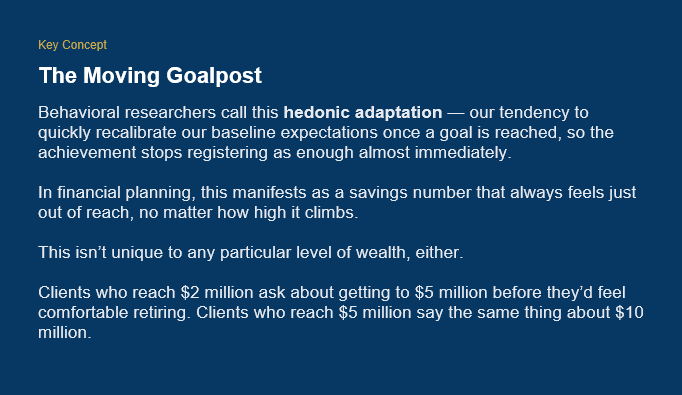
When he was 35 with $200,000 saved, $2 million sounded like a fantasy.
That kind of number would mean he made it, no more worries. Now that he’s there, his brain has already recalibrated, and he’s not comparing himself to his 35-year-old self anymore. He’s comparing himself to colleagues who seem to have more, to a cost of living that’s only gone up, and to a retirement that could realistically last 30 years or longer.
The moving target was driving him crazy.
Where the Fear Comes From
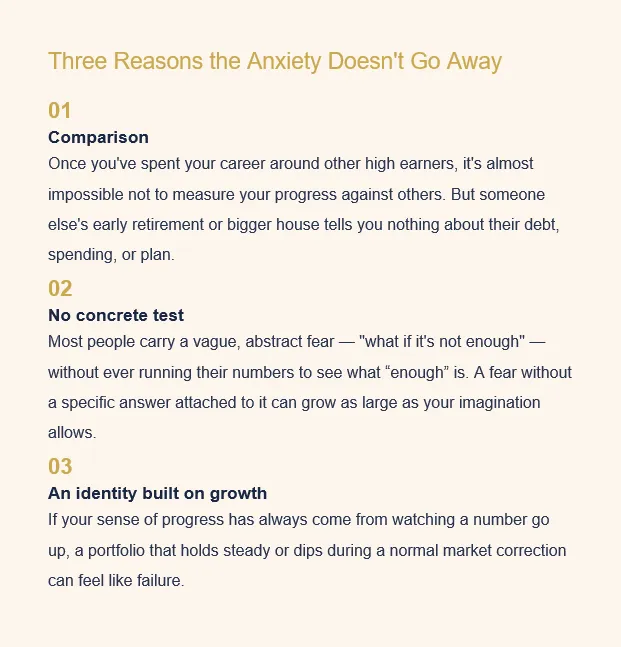
In my work as a behavioral financial advisor, I've noticed the "will I run out of money in retirement" worry rarely traces back to the money itself.
Three other things tend to drive it:
Turning a Feeling Into a Number You Can Test
When David and I sat down, we didn’t start by debating whether $2 million felt like enough. That question will never produce a satisfying answer.
Instead, we built a plan around his real monthly expenses, a realistic estimate of his Social Security payout, a healthcare cost projection, and a withdrawal strategy stress-tested against extended market downturns and a longer-than-average lifespan.
We modeled what his plan could look like if markets underperformed for several years in a row, and what adjustments he’d have available if that happened.
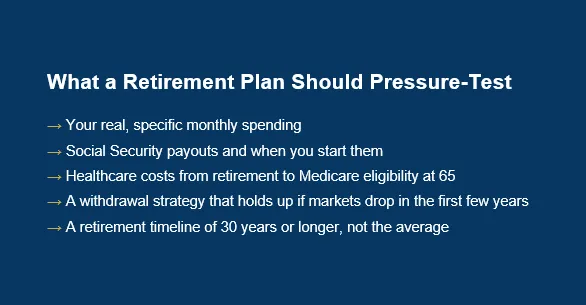
David now has a concrete picture he can evaluate and adjust throughout his life, instead of an open-ended, unanswerable fear.
The question of “Is $2 million enough to retire?” will keep your head spinning for as long as you let it.
Instead, take an approach that presents a specific, testable plan: “Here’s what my plan shows if the market drops 25% in my first three years of retirement, and here’s what we’d do about it.”
David still checks his statement more often than he probably should, but the dread is gone. He’s no longer carrying that vague, shapeless worry because he has a plan that’s been tested against the what-ifs that used to keep him up at night.
Clarity comes from knowing how your numbers hold up in your life.
"David" is a composite illustration drawn from common client scenarios and does not represent an actual client of Servet Wealth Management. Content in this material is for general information only and is not intended to provide specific advice or recommendations for any individual.
Follow us on YouTube!
Let's Meet
.png)
.png)
.png)
.webp)
About the author: Nathan Lee is a CERTIFIED FINANCIAL PLANNER® and Behavioral Financial Advisor at Servet Wealth Management in New York City. He works with individuals and families navigating important financial decisions, including retirement planning, tax strategy, investing, income planning, and wealth management. Through his blog and YouTube channel, Nathan explains complex financial topics in a practical, easy-to-understand way.

I read every email and would love to hear if this blog helped you.
.png)
.png)

