

News and Insights

The Social Security Regret I See Most in Seven-Figure Retirement Portfolios
If you’ve logged into ssa.gov lately, you’ve seen the page with three big estimated monthly benefits on it. One number shows your benefit if you claim at 62, one at full retirement age, and one at 70, all laid out like a menu you’re supposed to pick from.
What the page can’t show you is how your choice affects other retirement decisions you’re making.
If you’ve saved $1.5 million or more in a traditional IRA or 401(k), those three numbers represent just a small portion of your monthly retirement income. So for you, when you claim Social Security is less about the income than about what it does to your tax situation.
Clients who claimed Social Security before we began working together often realize they hadn’t fully considered how that choice would affect their taxes, investment withdrawals, and overall retirement plan.
What Your Social Security Statement Shows
The Social Security Statement estimates the amount of your monthly benefits if you claim at different ages.
If your full retirement age is 67, claiming at 62 permanently cuts your monthly benefit by about 30%. Every cost-of-living adjustment (COLA) after that applies to the smaller figure, so the gap widens over time. Wait past full retirement age, and you earn roughly 8% more each year you hold off, which means claiming at 70 pays about 77% more per month than claiming at 62.
It’s tempting to look at the largest number and assume waiting is the right call if you can afford it, and often that’s true. But when your portfolio — not Social Security — will cover most of your retirement income, the numbers themselves shouldn’t be the only drivers of your claiming decision.
What Else Affects Your Social Security Claiming Decision
For households with a large pre-tax balance, it’s important to weigh what claiming early does to your taxes as well as to your spouse should you pass away first.
If you’re in your late fifties or early sixties with a seven-figure retirement account, you’re probably making decisions around at least the following five questions:
- When can you actually stop working?
- How will you cover health insurance between your last day and Medicare at 65?
- Which account will you draw from first?
- Should you do Roth conversions, and how much should you convert?
- How can you prevent Required Minimum Distributions and Medicare surcharges from piling up on you later?
Each of those decisions affects the others. Your claiming age changes how much room you have for Roth conversions each year, what your Medicare premiums look like two years later, and how quickly you spend down your retirement accounts.
It works in reverse as well. When you stop working and how much you hold outside your IRA determine whether waiting to claim Social Security is even practical.
Your Statement describes just one benefit on its own, which leaves you making a six-part decision with a one-part tool.
The “Golden Window” Before RMDs Kick In
When you stop working, taxable income usually drops. You’re no longer bringing in a paycheck, bonuses, or vesting equity compensation. If you don’t immediately file for Social Security and you’re not old enough for Required Minimum Distributions, you may have several years where your reportable income is the lowest it’s been since early in your career.
I call that stretch the Golden Window, and for someone with a large pre-tax balance, it’s one of the best planning periods you have.
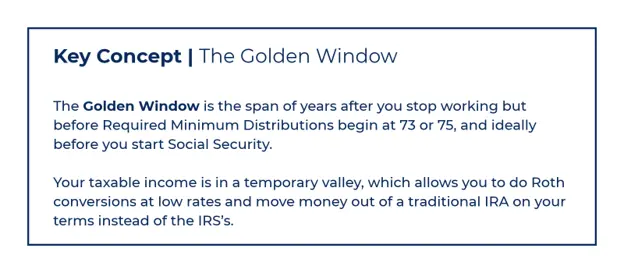
Claiming at 62 fills part of that valley. If your benefit runs $2,100 a month, that’s about $25,000 a year arriving in the years you wanted to keep income low. Depending on your other income, as much as 85% of your benefit may be taxable. Whatever bracket room the benefit takes up is room you can’t use for conversions.
The effect compounds, because the IRA you don’t draw down keeps growing. I’ve seen a $1.8 million IRA grow to $3.6 million in 10 years because the client didn’t need to touch it. While the growth was exciting, it resulted in a first RMD around $136,000+. Stacked on top of a pension and Social Security income, that client found himself in a higher tax bracket than he’d ever been in.
The real question is whether you want to spend a limited tax-planning window on benefit income you may not need yet.
“But What If Social Security Runs Out?”
This concern comes up often in my conversations, and many of my clients lean toward claiming early for this reason alone.
The 2026 Trustees Report projects that the retirement and survivors trust fund will run out of reserves in the fourth quarter of 2032, with payroll taxes still covering about 78% of scheduled benefits at that point. Considered together with the disability fund, which would take an act of Congress, the date moves to 2034 with roughly 83% payable.
So what’s projected is a smaller benefit rather than no benefit, because payroll taxes keep coming in and the program keeps paying what they cover.
If Social Security will be 15% of your retirement income, a 22% reduction to that slice is something your plan may absorb. Claiming eight years early to get out ahead of it means accepting a permanent 30% reduction to avoid a possible 22% one, and putting pressure on the conversion window while you’re at it.
For a household that depends more on Social Security to cover expenses, that math works out differently. I’d never tell someone in that position to shrug it off.
How Your Social Security Claiming Age Affects Your Spouse
If you’re married and you earned considerably more than your spouse did, your claiming age sets their income too, for as long as they outlive you.
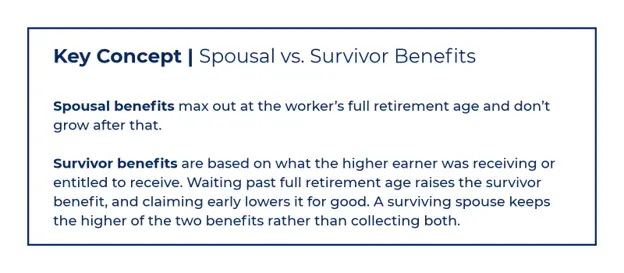
So ask yourself whether your spouse has a good chance of living into their eighties or nineties. If the answer is yes, delaying may do two jobs at once, giving you a larger benefit if you live a long time and giving them a larger one if you don’t.
However, you must also consider taxes. A surviving spouse files as a single taxpayer, with narrower brackets and lower IRMAA thresholds, often on income that hasn’t changed much. Conversions during the Golden Window and a larger survivor benefit both help with that.
When Should You Claim Social Security Early?
My position isn’t always to wait as long as possible. When a client who has saved plenty tells me they’re thinking about claiming early, I don’t immediately jump to calculations. I ask whether that monthly income would actually change what they do in their healthiest retirement years.
Their answer tells me which problem we’re solving. The plan often already shows success at a high confidence level, so it’s more about feeling the ‘permission’ to spend than the actual numbers.
Watching a portfolio balance go down, even when the plan says it’s supposed to, is hard for some people. They won’t spend it no matter what the projection shows. A deposit arriving from outside every month solves a psychological problem in that case.
If claiming at 64 is what gets somebody on the Alaska cruise, or over to Europe while the knees still cooperate, or taking the grandkids to Disney when the grandkids still want to go, then the conversion math doesn’t matter. Those years don’t come back, and a plan that saves taxes while the client stays home hasn’t really done its job.
So this is a trade-off rather than a rule, and I’d want to know whether you’re short on tax flexibility or short on permission before I had any opinion about your claiming age.
There are also situations where claiming early is simply the better answer, like a health diagnosis that changes your expectations, a lower-earning spouse whose household survivor benefit runs off someone else’s record, or needing the income so you aren’t selling investments into a down market in your first years of retirement.
How To Determine When You Should Claim
I can’t tell you the best age to claim Social Security from here, and I’d be careful with anyone who offers one without knowing your full situation. What I can tell you is which questions change the answer.
- How large is your pre-tax balance, and what might your first Required Minimum Distribution look like if you leave it alone until 73?
- How many years sit between your last paycheck and that first distribution?
- Can you cover your spending from taxable and cash assets through those years without selling at a bad time?
- Would the monthly income actually change what you do, or would it sit in an account?
If you come up with conflicting answers, that’s normal. This isn’t an easy decision. But since your optimal claiming age is tied to your tax situation for the next 20+ years, it's worth deciding alongside the other five questions you’re juggling rather than in a silo.
Prefer to watch?
Content in this material is for general information only and is not intended to provide specific advice or recommendations for any individual.
Follow us on YouTube!
Want to Learn More?


About the author: Nathan Lee is a CERTIFIED FINANCIAL PLANNER® and Behavioral Financial Advisor at Servet Wealth Management in New York City. He works with individuals and families navigating important financial decisions, including retirement planning, tax strategy, investing, income planning, and wealth management. Through his blog and YouTube channel, Nathan explains complex financial topics in a practical, easy-to-understand way.

I read every email and would love to hear if this blog helped you.


